
Monroe County Parole Versus Probation
Probation and parole do not mean the same thing in Monroe County. Probation is a sentence imposed by the circuit court, often without a state-prison term. The 24th Judicial Circuit provides local probation services and keeps the court case that states the order. Parole and mandatory supervised release, often shortened to MSR, follow Illinois Department of Corrections custody. IDOC's Parole Division supervises that person, while the independent Illinois Prisoner Review Board sets release conditions and hears many alleged violations.
The source matters. A Monroe County court case may confirm probation but is not a statewide parole database. An IDOC result may confirm parole or MSR but does not cover a person whose only sentence was county probation. The systems can also overlap when a person has more than one case, so match the full name, case or IDOC number, date of birth when available, and the agency that issued the status.
| Point | Probation | Parole or MSR |
|---|---|---|
| Source | Sentence of the circuit court | Follows IDOC prison custody |
| Local or state path | 24th Judicial Circuit court services | IDOC Parole Division and Prisoner Review Board |
| Public starting record | Monroe criminal case and clerk record | IDOC Individual in Custody Search |
| End record | Court order showing completion or termination | IDOC archived record or PRB final-discharge order when applicable |
- Probation
- A court sentence served under local supervision in the community.
- Parole
- Conditional release used chiefly for Illinois indeterminate sentences and certain specialized reviews.
- MSR
- Mandatory supervised release, the state supervision period that follows many determinate prison sentences.
- Discharge
- The formal end of custody and supervision under the sentence.
Verify Monroe County Post-Release Supervision
Start with the custody that came before supervision. A person released from Monroe County Jail after a local court order may be on probation or pretrial supervision. A person who left an Illinois prison may be on parole or MSR. The IDOC Individual in Custody Search is the public starting point for current state supervision. Its working search accepts a last name, IDOC number, or birthdate and may show Offender Status, Location, Last Paroled Date, Projected Parole Date, and Projected Discharge Date.
- Classify the prior custody. Use the Monroe court case for a county-jail or probation path. Use IDOC after a state-prison term.
- Match the person. Compare identifiers and dates. A similar name alone is weak proof.
- Read the exact label. Current status, last parole date, and projected discharge date answer different questions.
- Check the issuing record. For probation, obtain the court order. For parole or MSR, use IDOC and any relevant PRB order.
- Use the archive when needed. A fully discharged IDOC person drops from the public online search. Select Record Search through IDOC Contact Us for the archived result.
A no-result is not automatic proof that supervision never existed. It may mean the name was entered differently, the person was supervised only through the court, or the IDOC sentence is fully discharged. The Monroe County released-inmate search path helps distinguish a jail release, state discharge, transfer, and court disposition.
For a current IDOC match, separate the fields before drawing a conclusion. Offender Status and Location describe the present state record. Last Paroled Date is a past event. Projected Parole Date is an estimate that can change, while Projected Discharge Date usually concerns the expected end of the sentence and supervision. A result that says parole or MSR confirms release from the prison setting, but it does not identify every condition or prove that supervision has ended.
Monroe County Probation Contacts
The 24th Judicial Circuit Monroe County page lists the local court staff tied to probation and pretrial services. These contacts are not general inmate locators. Person-specific details may be limited by court rules and disclosure law, so have the case number and ask for the correct public record or office.
24th Judicial Circuit
Probation: Courtney Schweickhardt, 618-939-8681 ext. 277
Probation: Melanie Mueller, 618-939-8681 ext. 310
OSPS pretrial: Amanda Jaycox, 217-991-0444
OSPS means Office of Statewide Pretrial Services. Pretrial supervision applies while a criminal case is pending and is not probation after conviction. For state parole or MSR, use IDOC Contact Us or call the public IDOC number at 217-558-2200. The current Prisoner Review Board contact source should be checked before mailing because older IDOC material and current PRB material show different Springfield addresses.
The Circuit Clerk record is useful when the question is whether the judge ordered probation, changed a term, or ended the case. Ask for the docket entry or order rather than an informal account of supervision. Court records can show the legal action, but the probation office may still control what person-specific operational details it can release. Keeping those roles separate avoids treating a phone response as a certified order.
The official PRB revocation schedules show how the Board publishes hearing information.
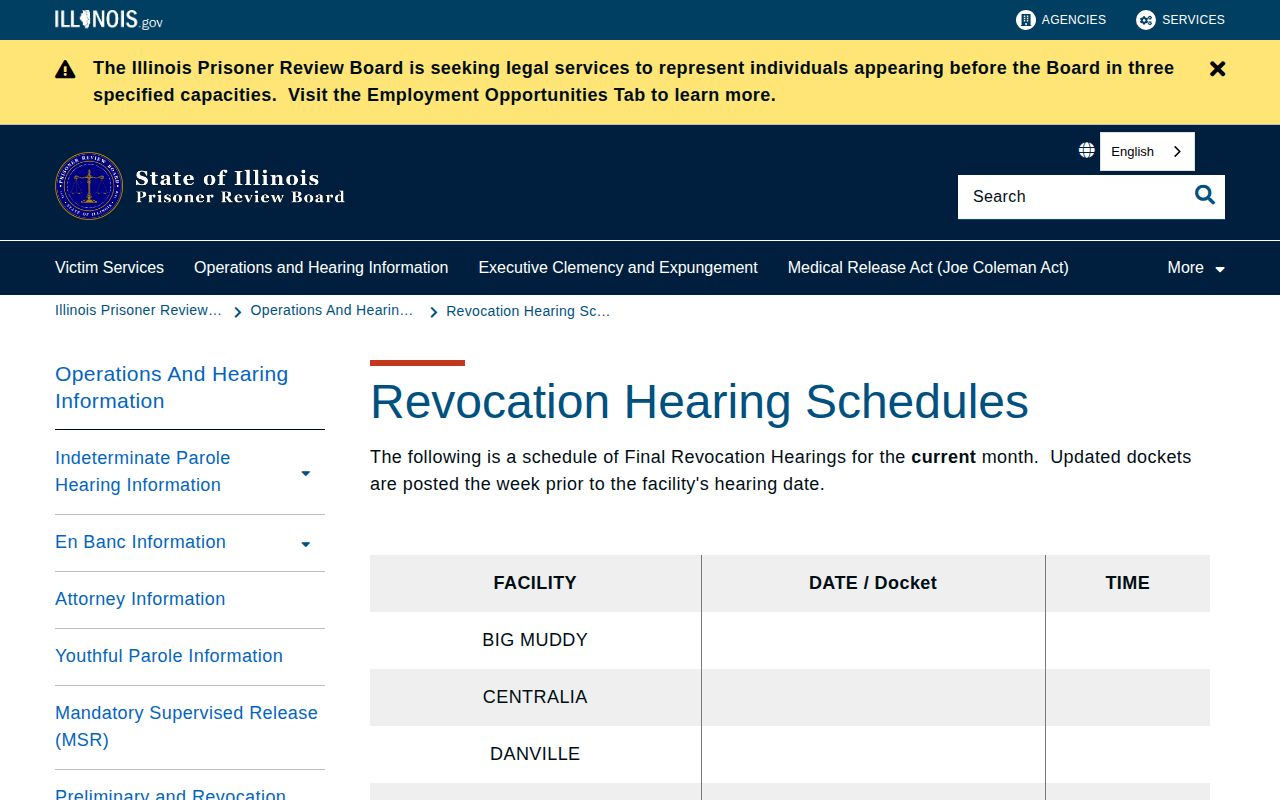
The schedule is a hearing source, not a complete Monroe County parole roster, and any result should be matched to the correct person and proceeding.
Monroe County Supervision Violations
Conditions are rules attached to release. Their exact terms come from the court order, IDOC plan, or PRB order, not from a general web summary. An alleged breach can lead to a report, warrant, hearing, added conditions, or a return to custody. A warrant for an alleged parole or MSR violation is not a new conviction. Under 730 ILCS 5/3-3-9, such a warrant can stop the supervision clock until the case reaches a final determination.
An absconder is a person alleged to have stopped reporting or left supervision without approval. Monroe County publishes no verified local absconder list. The lack of a public listing therefore does not establish that no warrant exists. Check the Monroe court case for local probation action, IDOC for state status, and official law-enforcement channels when a warrant question must be resolved. PRB revocation materials may show a scheduled hearing or outcome, but they are not a universal historical name search.
Illinois VINE can send source-reported custody and case events. It does not replace the warrant, violation report, or final order. A VINE release event can also mean release from one reporting source followed by transfer to another.
Note: Treat a supervision allegation as pending unless the issuing court or board record states a final outcome.
Monroe County Supervision Discharge
Supervision ends through an official act, not merely through the passage of an estimated date. A probation case may end with a court entry showing satisfactory completion, termination, or another disposition. Parole or MSR may end at final discharge under the state sentence. In some eligible matters, the Prisoner Review Board considers early final discharge. The correct proof is the order or agency record that marks the end.
IDOC's public search is designed for people now incarcerated or on parole. Once the sentence is complete, the online entry stops displaying. That absence can be consistent with discharge, but it is not a permanent public certificate. Request IDOC's archived Record Search with the full name, date of birth, approximate admission year, institution, conviction county, and relevant dates. A relevant final-discharge order from the PRB may provide a second official source.
Projected Discharge Date is not the same as a confirmed final discharge. It can change, and it may refer to the expected end of the whole sentence and supervision rather than the day a person walked out of prison. Read the actual label and confirm the completed event through the record holder.
Monroe Parole Board Record Limits
The Illinois Prisoner Review Board does not choose every prison exit date. For most determinate sentences imposed for post-1978 offenses, IDOC calculates the sentence under statute and the Board sets release conditions. The discretionary indeterminate parole process chiefly concerns older pre-1978 crimes. Illinois also provides specialized youthful-parole review for some eligible modern sentences. Those distinctions explain why a person can have a projected release date in IDOC without appearing on a general parole-vote calendar.
PRB publishes monthly calendar material, En Banc agendas, parole interview dockets, revocation schedules, and revocation results. Each has a narrow purpose. A calendar date is not a grant of parole. A revocation schedule shows a proceeding, not a final finding. Published results can identify an outcome, while the final order is the better record when the exact terms matter. For a public order that is not posted, use the PRB FOIA channel.
In a revocation matter, a panel may find a violation and return the person to release with or without added conditions, find no violation and resume release after plan approval, or revoke release. IDOC then recalculates custody and release as required. An appeal may affirm, reverse, or reset the result. None of those supervision outcomes should be recast as a new criminal conviction. If a separate Monroe County criminal charge exists, that case must be read on its own docket.
Property After Monroe County Release
The Monroe County Sheriff's jail property rule provides a practical clue about what happened after local custody. It says personal property is returned to the owner at release. If the person is transferred to IDOC or the Federal Bureau of Prisons, the person may authorize someone else to collect the property. A jail departure can therefore mean community release, state transfer, or federal transfer.
Unclaimed property is destroyed after 60 days under the published rule. Anyone collecting for a transferee should confirm the sheriff's authorization process promptly. Property handling is not, by itself, proof of parole, probation, or discharge. Pair it with the jail's discharge or transfer record and then check the receiving state or federal system. This Monroe-specific rule is useful because it keeps a jail exit from being mistaken for freedom in the community.