
Monroe Projected and Actual Release
A projected date is a calculation based on facts known at that point. It can describe a planned move from prison to supervision or the expected end of a sentence. The actual release is the event that occurred. At Monroe County Jail, that event should appear as a discharge or transfer time in the sheriff's existing record. For IDOC custody, the public detail uses several precise labels that must not be collapsed into one generic date.
A pretrial detainee is different. There is no sentence term to reduce with credit. Release may follow a judicial pretrial-release order, satisfaction of a condition, dismissal, or another court action. The Monroe criminal docket can show the legal reason, while the sheriff's timestamp shows when physical county custody ended. If the court instead commits the person to IDOC, leaving the county jail is a transfer and not a return to the community.
“Release” can also mean leaving the prison building for mandatory supervised release, often called MSR, while the sentence continues. Discharge means the sentence and supervision have ended. Those two events can occur years apart. Read the label before relying on the date.
Find Monroe County Projected Dates
Start with the person's last known custodian. The IDOC Individual in Custody Search is appropriate only after a state commitment. It does not cover someone whose custody never went beyond Monroe County Jail. Search the state form by last name, IDOC number, or birthdate, then match the person and sentencing county carefully.
- Determine whether the person is pretrial, serving a county-jail sentence, in IDOC, or under federal custody.
- For IDOC, search by surname, IDOC number, or birthdate and open the correct detail record.
- Read Projected Parole Date, Projected Discharge Date, status, location, and the sentencing blocks as separate fields.
- For Monroe jail custody, check the court's sentencing or release order and ask the jail for its calculation or discharge record.
- When the dates conflict or have high practical importance, obtain written confirmation from the calculating office.
The Monroe County Jail can be reached at 618-939-8651. Ask whether the person is held and which existing record contains the release or transfer event. A written request can seek the date and time received, discharged, or transferred, plus a disposition or destination if maintained. The Monroe case through the 24th Judicial Circuit can supply the sentence, custody credit, later orders, and legal basis for release.
Use the Sheriff's Correctional Division for the jail source, the 24th Judicial Circuit Monroe page for court access, and the Monroe County FOIA page for written county requests. Each channel answers a different part of the date question.
The state landing page below shows the official route to the working IDOC search.
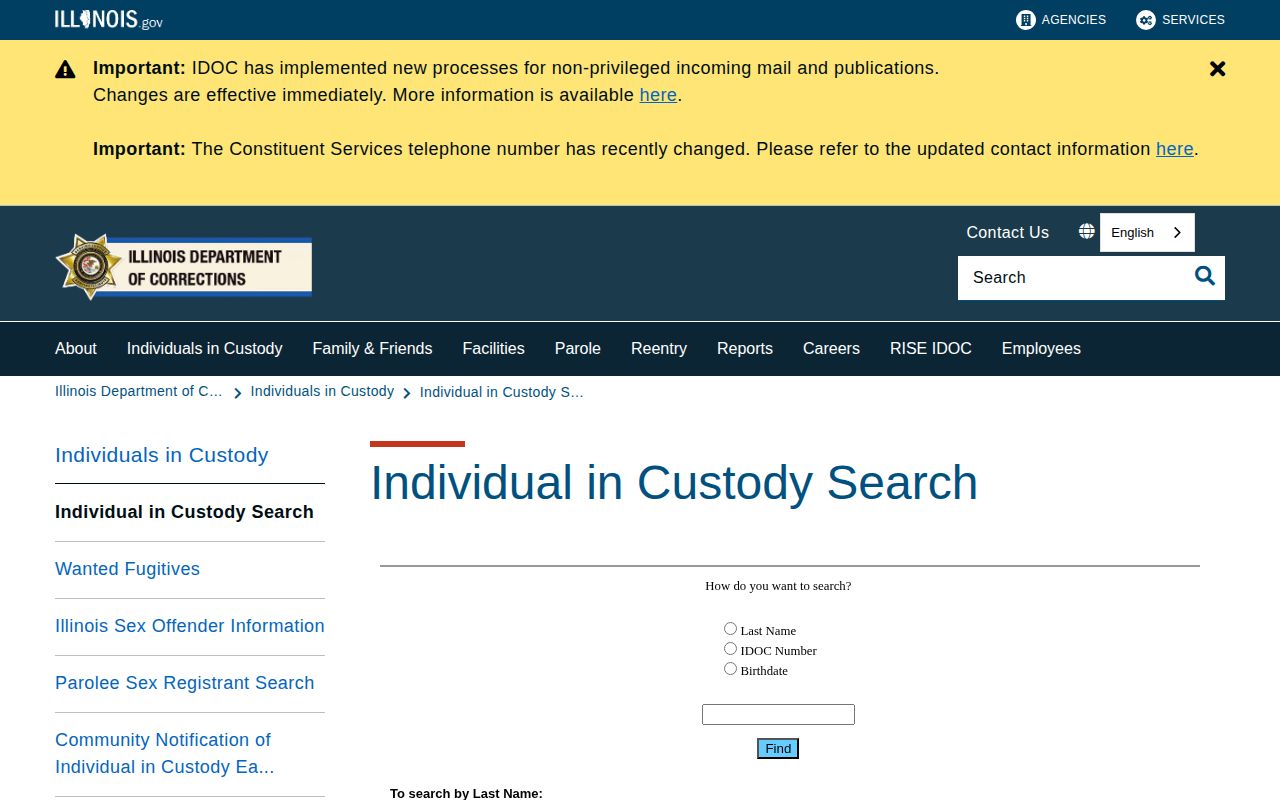
The public form leads to the live result, where the exact projected fields and sentence blocks must be read together.
Monroe IDOC Release Date Labels
IDOC's wording answers three different questions. Projected Parole Date is prospective and can change. It concerns the projected transition from prison custody under the sentence calculation. Projected Discharge Date generally concerns the expected end of the overall sentence and supervision. Last Paroled Date is historical. It records an earlier event and should not be presented as the next scheduled date.
| IDOC field | How to read it |
|---|---|
| Offender Status | The person's current reported position within IDOC custody or supervision. |
| Location | The institution, supervision placement, or location label currently reported. |
| Projected Parole Date | The current calculated transition point from prison custody, subject to change. |
| Last Paroled Date | A past parole or MSR event, not a forecast. |
| Projected Discharge Date | The projected end of the sentence or supervision, not merely prison exit. |
| Sentence Discharged? | Whether the specific sentence block is marked discharged. |
Sentence blocks also show the county, offense, custody date, term, mittimus or case details, and discharge status. A mittimus is the court's commitment order. Multiple blocks may reflect concurrent terms served at the same time, consecutive terms served one after another, or more than one case. That is why one visible term cannot safely be multiplied by a percentage to produce a date.
The live search form captured below accepts the state query that leads to these details.
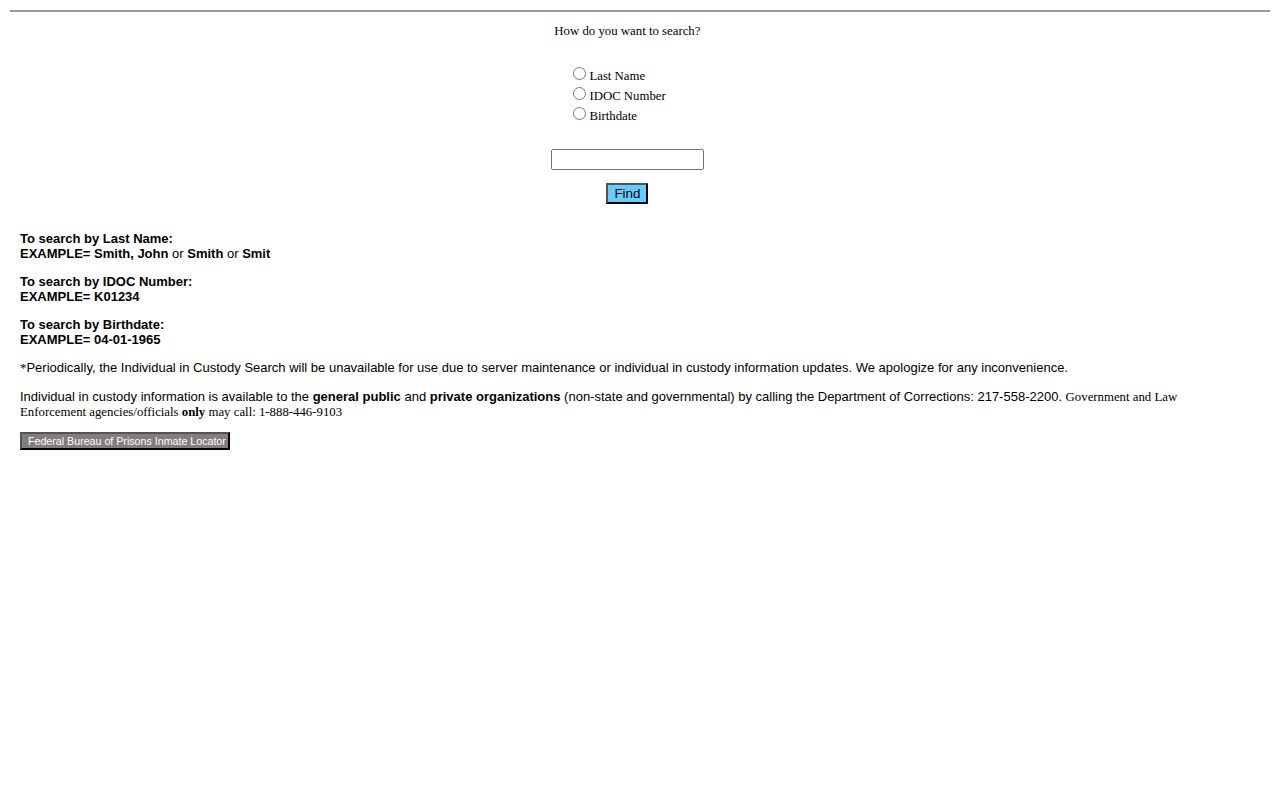
Because the live system is session based, the result may not have a stable link. Keep the IDOC number and request written confirmation when needed.
Illinois Credit for Monroe Sentences
Illinois does not have one universal 85 percent rule. IDOC describes statutory service rates of 50, 75, 85, or 100 percent, depending on the offense and governing law. First-degree murder is generally a 100 percent case. Listed violent truth-in-sentencing offenses can require 85 percent, certain drug offenses can use 75 percent, and many other determinate terms use 50 percent. The offense date, conviction, enhancement, and applicable version of the law all matter.
The controlling framework is 730 ILCS 5/3-6-3 together with IDOC's sentence-calculation directive and Appendix A. Statutory Sentence Credit produces the applicable service rate and can be lost for conduct. Program Sentence Credit may be earned through qualifying programs, with excluded offenses and rate floors. Earned Sentence Credit is discretionary, may reach 180 days, requires more than 60 days in IDOC custody, and excludes offenses identified in the statute. Eligibility is not an award.
- Statutory Sentence Credit
- Credit tied to the legal service rate for the offense, subject to loss.
- Program Sentence Credit
- Credit associated with qualifying program participation and statutory limits.
- Earned Sentence Credit
- A discretionary IDOC award with custody-time and offense exclusions.
- MSR
- Mandatory supervised release, a period of state supervision after prison custody.
IDOC directives preserve the statutory floors. Credits cannot lower a 100 percent case below full service or an 85 percent case below 85 percent. Seventy-five percent cases have their own floors. The Facility Records Office applies and revises the calculation. A changed projected parole date from Earned Sentence Credit should appear on the public profile after action is taken.
Why Monroe Release Dates Move
A projected date changes when an input to the sentence calculation changes. Some changes add credit, while others remove it or reveal a term that was not reflected in an earlier reading. A transfer hold can also change where the person goes without changing the underlying sentence end. Treat each update as a reason to recheck status, location, and all sentence blocks.
| Factor | Possible effect |
|---|---|
| Credit loss or restoration | Discipline or later restoration can move the projected parole date. |
| Program or earned credit | An awarded credit can advance the date, within statutory floors. |
| Jail custody credit | Credited pre-sentence custody affects time remaining. |
| Concurrent or consecutive terms | The relationship among sentences changes the combined calculation. |
| New mittimus or court order | A corrected or additional commitment can require recalculation. |
| Detainer or hold | Another custodian may receive the person instead of community release. |
| MSR violation | Violation proceedings can affect custody and the path to final discharge. |
Other inputs documented by IDOC include writ time, escape or absence, program completion, multiple mittimuses, and supervision violations. A detainer is a request by another agency, not proof that transfer occurred. Verify the receiving custodian after the physical departure. The court order, jail record, IDOC status, and receiving system can each be accurate while describing a different link in the chain.
Monroe Jail Release Calculations
A jail-only sentence does not use the public IDOC projected fields. The sentencing order, lawful jail custody credit, and sheriff's calculation control. No Monroe-specific county good-time policy was identified in the research. That absence makes it unsafe to import an IDOC percentage, a rule from another Illinois county, or an online calculator into the local date.
Start with the Monroe court case. Identify the sentence, the date it began, credit stated in the order, and any later amendment. Then ask the jail which existing record states the calculated release and whether a hold or transfer affects the planned departure. If a date is given only by phone, request the underlying record when exact written proof is important. Illinois FOIA requires a request for existing records, not a new calculation or legal explanation.
For pretrial custody, the court and jail remain the key pair. A court may order release, but processing and any other hold affect when the person physically leaves. Conversely, disappearance from a custody view is not proof of release. Monroe County does not publish an official online jail roster or recent-release feed, so direct source confirmation carries extra weight.
Archived Monroe IDOC Date Records
IDOC's public search covers people who are incarcerated or on parole or MSR. Once a person completes the sentence, the online record stops displaying. A no-result can therefore mean full discharge, a weak name match, or a search problem. It cannot answer the question alone.
Use IDOC Contact Us and choose Record Search for archived information. Helpful inputs include the full name, date of birth, approximate year received, institution, conviction county, and relevant dates. IDOC's FAQ says potentially public information includes admission and release dates and sentencing information, though other master-record material can remain confidential unless lawful process permits disclosure.
The captured IDOC FAQ below documents the archived-record limit and sentence-credit context.
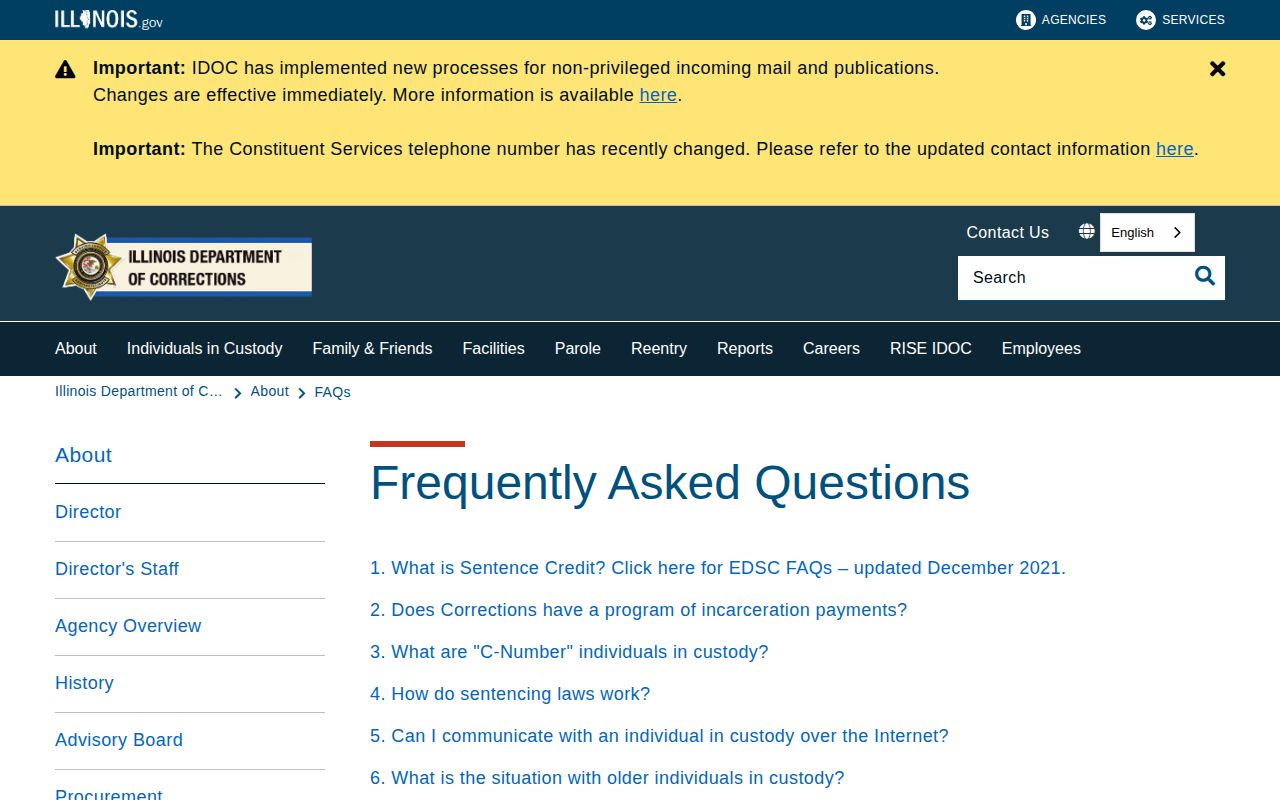
Archive access is essential for a fully discharged former state prisoner because the live locator is intentionally not a permanent historical index.
Confirm Monroe County Release Dates
Use the office responsible for the date. IDOC Facility Records Offices calculate and recalculate state sentences. The Monroe jail and court supply the local sentence, custody credit, order, and physical discharge or transfer event. BOP handles federal sentenced custody. These sources are not interchangeable.
Illinois VINE can send a pending custody-change notice, but it does not calculate the date or issue the release order. Registration mechanics and source limits are covered on the Monroe County VINE inmate check. After an alert, verify the event with the agency named in the VINE result.
For an IDOC discrepancy, compare Offender Status, Location, Projected Parole Date, Projected Discharge Date, and each sentencing block. Then ask IDOC for written confirmation rather than attempting an independent percentage calculation. The live result warns that data changes quickly and identifies the Public Information Office at 1301 Concordia Court, P.O. Box 19277, Springfield, IL 62794-9277 as a written-confirmation route.
The final check is the actual event. A court order explains legal authority. A jail timestamp records county departure. IDOC reports state status. A receiving agency confirms transfer. Keeping those facts separate prevents a projected date from being mistaken for proof that someone has already left custody.